


Equip, the Alabama-based leader in delivering integrated software platforms for higher education organizations serving students with intellectual and developmental disabilities, has announced the strategic evolution of its proven, outcomes-based portfolio to support community rehabilitation providers (CRPs) and the individuals they serve.
The new rebranding and integrated services platform signify Equip’s long-term, overarching commitment to help drive meaningful, measurable outcomes for all people with disabilities. The move includes the roll-out of a comprehensive set of dedicated tools and services, a brand refresh that reflects the company’s mission centered on Clarity, Connection, and Growth and a revamped website that facilitates participant onboarding and success.
“This expansion of our target marketing and support services is in direct response to the growing needs of community-based organizations dedicated to helping all active participants achieve greater independence in work and in life,” said Trent Kocurek, founder & CEO of Equip. “We’ve been actively working with CRPs for the past 13 months, and this announcement marks the formal availability of these proven CRP-focused benefits to the broader market.”
A Two-pronged Delivery Approach
Equip serves two sets of customers simultaneously: the individuals working toward their own independence and the community rehabilitation providers working alongside them to maximize their success. The focus of the company’s new marketing efforts and brand identity signifies the company’s ongoing commitment to ensuring both the progress of those initiatives and the improved ability of CRPs to measure and document that success.
“Our primary purpose is to help deliver meaningful outcomes,” reminded Kocurek. “Everything we do is documented and measured to achieve this overarching goal. But as we’ve immersed ourselves deeper and deeper into understanding and meeting these individual needs, we have come to recognize the critical role community rehabilitation providers play in making that happen.”
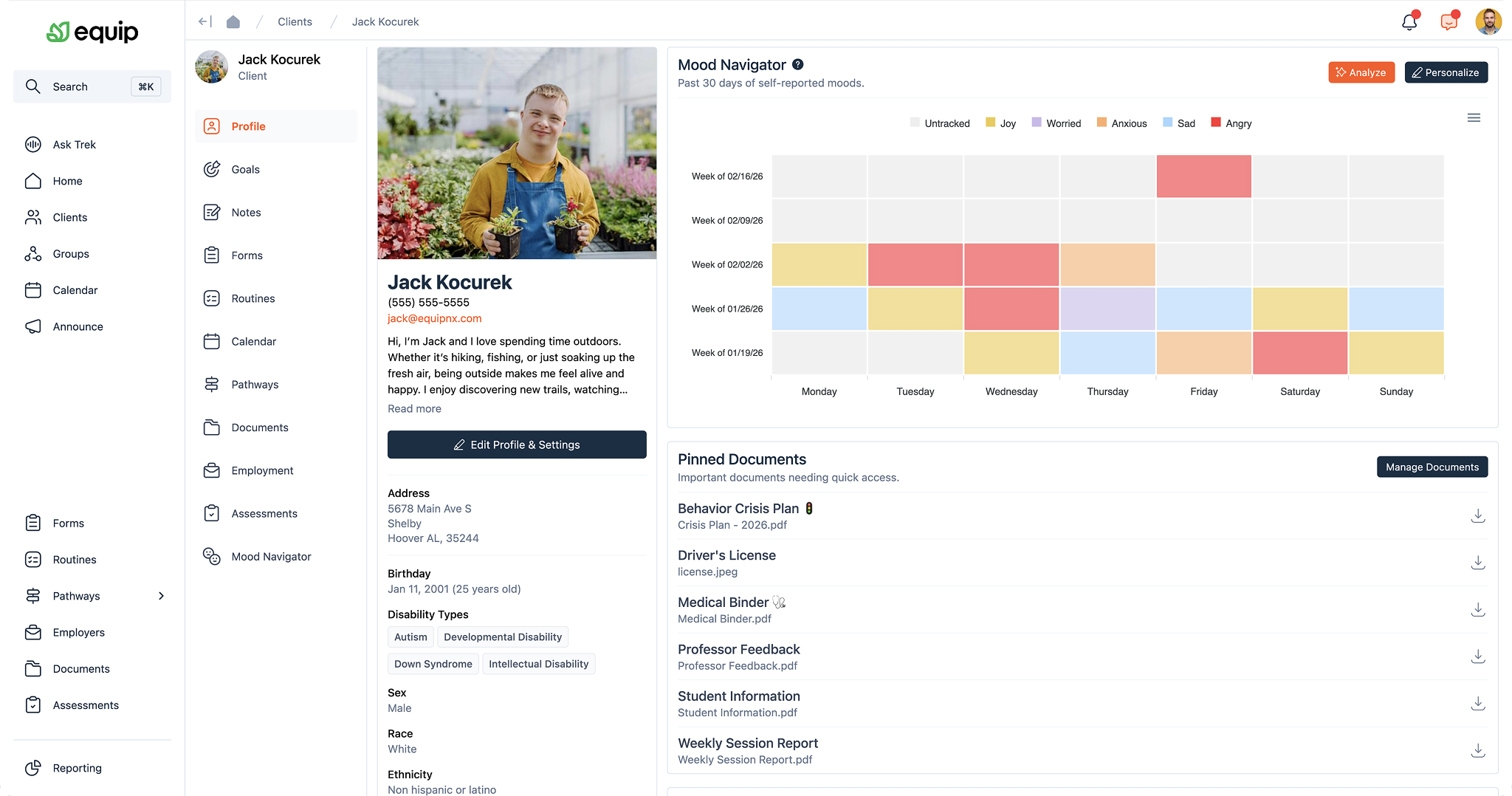
Kocurek also highlighted the critical importance of new AI-based features and functionality in freeing up precious time for community services providers to spend with their program participants – the individuals in need.
“Equip gives community services providers more time to serve people with intellectual and developmental disabilities and less time filling out paperwork.”
The expanding set of AI-based data collection and analysis features Equip is deploying also reduces the time-consuming burden of administrative reporting tasks required to ensure the continuation of local area funding for the important services they provide.
“Increasing the amount of time community care providers have each day to do what they want to do most – serving participants – offers them a tremendous benefit in and of itself,” said Kocurek. “But our use of AI also provides them with valuable insight into what’s working and what’s not – trend lines that can be applied across many of their participants experiencing similar challenges.”
Measuring Success in the Wrong Way
Most platforms are built to track services delivered. Very few are built to track actual progress achieved, and no product in the market today offer a fully integrated solution based on improving and tracking outcomes as the defining measurement of success.
The result of this short-sighted, services-based tracking is we now have a sector that has built its workflows around compliance, not around people.
All employment and transition programs generate enormous amounts of data. Intake forms, service logs, goal plans, progress notes – the documentation load never ends. But tracking documentation and ensuring improved outcomes are not the same thing.
Data exists at every stage of support – but it’s rarely connected across stages. Everyone owns a piece of the lifecycle, but no one owns the whole journey. And the most important question – ‘Is this person more independent than they were before?’ – too often goes unanswered.
“Every system tracks services,” Kocurek notes, “but you shouldn’t have to stitch together five different tools to understand one person’s journey. We’ve built an integrated infrastructure that tracks progress – Equip is the only solution that generates and tracks improved outcomes and independence across the entire lifecycle of support.”
Clarity, Connection, and Growth in Practice
The three pillars of the new Equip brand identity are not aspirational – they embody what the platform already delivers and represent the standard Equip holds itself up to as it grows.
- Clarity means every stakeholder — coordinators, coaches, employers, families — sees the same reality at the same time: where someone stands, what’s been done, and what comes next.
- Connection means the entire support network operates from a shared understanding, not in silos.
- Growth means the system is always oriented toward a single outcome: measurable, documented progress toward independence.
According to Dr. Betty Patten, Jay and Susie Gogue Endowed Director of the EAGLES Program and Associate Clinical Professor in the Department of Special Education, Rehabilitation, and Counseling at Auburn’s College of Education, “Equip provides a structure that exists within a platform – not just in someone’s head. It serves as a centralized touchpoint creating clarity, consistency, and alignment across the entire program.”

Jeff Metzger, Director of Director of All In, an Atlanta-area program offering community-based independent living for adults with mild to moderate intellectual and developmental disabilities or acquired brain injuries, noted that Equip gives their participants more control over their individual program.
“It’s truly their program,” said Metzger. “They get to interact with it and do things that – before Equip – they were relying on us to handle for them. The best result was our Mavericks becoming more independent and taking more ownership of the process.”

“Equip is a regular vocabulary term for us – we use it as both a noun and a verb. ‘Equip it!’ It’s a constant part of our very being.”
Built for the Full Lifecycle — and a Growing Range of Programs
The new marketing focus and brand identity arrives as Equip expands its presence across employment programs, transition programs, support coordination and transitional living support wherever organizations are focused on building employment skills and independent living skills in the communities they serve. The integrated platform directs and manages critical care threads across the full arc of an individual’s progress, from intake through planning, daily execution and long-term outcome tracking.
“When that continuity exists,” concludes Kocurek, “community rehabilitation providers and their programs can do more than deliver valuable services – they can document and prove the impact of those efforts to ensure crucial sources of funding going forward.”
“That’s the way it should be – dedicated community services providers working hand-in-hand with participants to deliver meaningful outcomes while assuring the longer-term financial viability of those programs. That’s what makes Equip tick.”
Kocurek also thanked Auburn’s New Venture Accelerator and the AU Kickstart Fund for their recent non-dilutive $50,000 grant.
“We are tremendously grateful for all the support we get from across the Auburn Entrepreneurial Ecosystem, from the funding we’ll use in fueling these efforts to the confirmation from the Kickstart Fund’s Investment Committee that we’re on the right track.”
“That matters a lot!”



.svg)
.svg)


